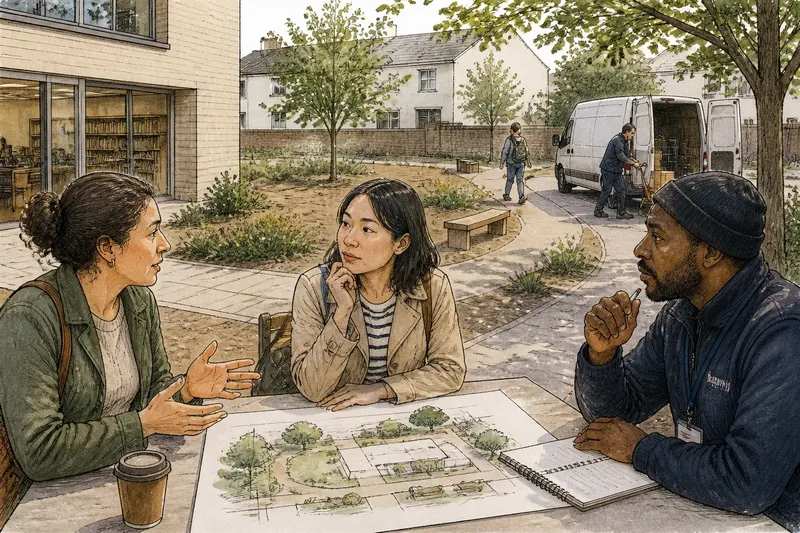
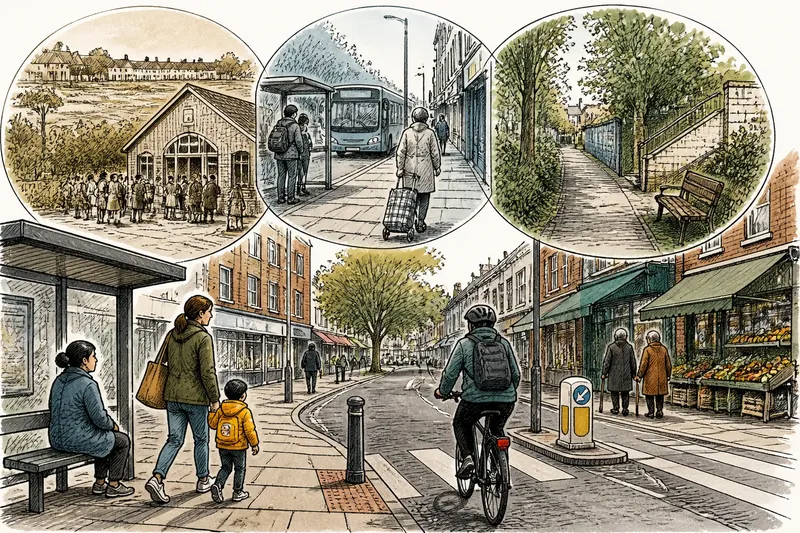
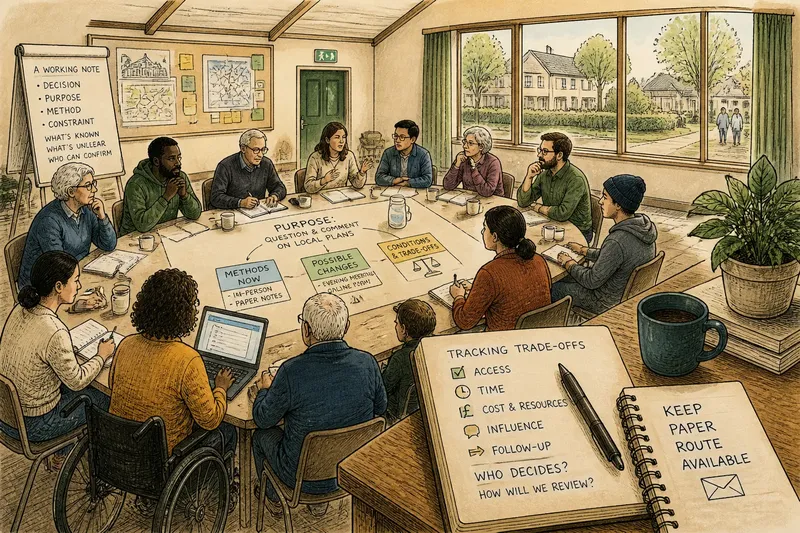
A Scenario Is a Question, Not a Forecast
A local scenario helps residents compare civic choices, uncover whose needs may be missed and decide what information to seek before a decision is made.
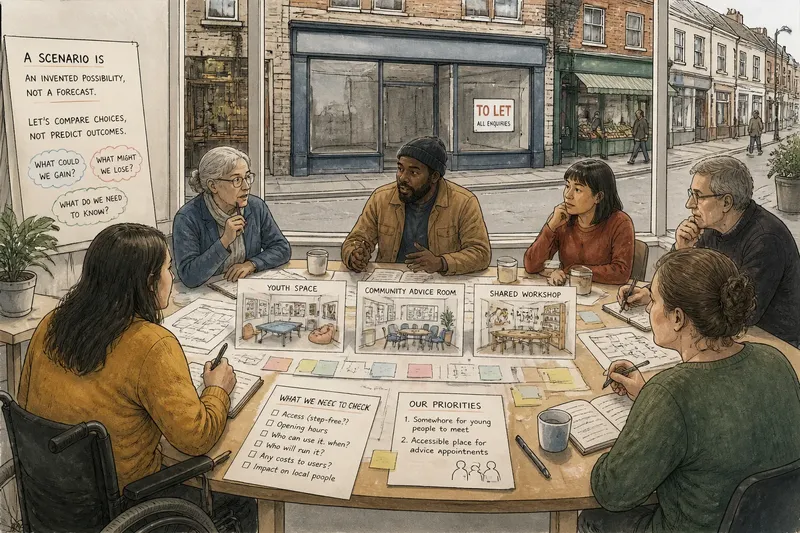
What can residents do when a council or service provider is considering a change, but its local effects are not yet clear? A local scenario lets a group examine how different choices might shape a familiar place, without presenting an imagined outcome as a forecast.
The distinction is useful because civic conversations can get stuck on whether a prediction is right. Scenarios ask a different question: if a particular choice were made, what would residents need to weigh? They are less about describing the neighbourhood’s future than about clarifying the choices on the table now.
Scenarios and forecasts
A forecast makes a claim about what is expected to happen, usually on the basis of evidence and a stated method. A scenario sets out a possible situation so people can consider its consequences. It may draw on known local conditions, but it does not establish that its events will occur.
For a neighbourhood deciding how to use an empty shopfront, a forecast might estimate demand for a proposed service. A scenario could instead compare what residents might gain or lose if the space became a shared workshop, a small food shop or a community advice room. The comparison is a prompt for weighing priorities, not a claim that any option will succeed.
A vivid account can sound like an official announcement, particularly when it names a recognisable street or institution. Put a plain statement near the beginning that the scenario is an invented possibility, then keep proposals, verified details and imagined consequences distinct.
Choices before predictions
Scenarios are most useful when a group has a genuine choice to examine. They can bring different priorities into view: a quiet place to meet, convenient access to everyday services, or room for local organisations to work. The aim is not to find a single story everyone accepts. It is to understand what each option asks of residents and decision-makers.
Say a residents’ group is discussing an empty shopfront. Its starting inputs are a vacant ground-floor unit on the high street, a council discussion about temporary use, and two expressed priorities: somewhere for young people to meet and an accessible place for advice appointments. In an invented scenario, the group supposes the unit becomes a youth club on weekday afternoons. It writes down that the space is not open for advice appointments then, asks who can use it at other times, and identifies opening hours and access arrangements as matters to check. The resulting answer is not that the club is best: it is that the idea may meet one stated need while leaving another unresolved, so the group should ask about shared use and access before comparing options.
That kind of discussion can separate a preference from a practical constraint. A resident may favour a workshop but need to know whether the entrance can accommodate a wheelchair; another may favour advice sessions but worry that they would be difficult to find. Those are different concerns, and neither needs to be flattened into a single agreed narrative.
Questions for civic scenarios?
Does a scenario need to be likely?
It should be plausible enough for people to discuss seriously, but it need not be described as the most likely outcome. Its value lies in making a choice or trade-off easier to examine.
Can a scenario include a preferred option?
Yes, but state that it is an option someone favours, not an outcome that has been decided. Naming the conditions it would require helps residents distinguish support for an idea from confidence that it can be delivered.
What if residents disagree?
Record which assumption or priority is disputed rather than editing the disagreement away. That difference may point to a missing voice, a question for a decision-maker or a need to compare another option.
What should the group do next?
Turn open questions into requests for information, conversations with affected people or points to raise with the relevant decision-maker. Keep each request tied to the choice under discussion so the scenario does not become a substitute for a decision.
Conditions and trade-offs
Every scenario is selective. It may assume that a space stays available, that an organisation can run it, or that people can reach it. State such conditions plainly. Otherwise, readers may be imagining different versions of the same proposal without knowing it.
Use an everyday analogy: a scenario is like a map with several possible routes marked. The map helps a group compare turns and obstacles; it does not say which route will be taken. For a local discussion, the equivalent is separating these statements:
- Known detail: If the shopfront is confirmed as vacant, use that fact as a starting point; if it is not confirmed, ask the property owner or council before relying on it.
- Access condition: If the entrance is step-free, include it as a possible benefit; if that is unknown, make an access check a condition of comparing uses.
- Operating assumption: If a proposal assumes volunteers will open the room, ask who could take on that role; if no one is identified, do not treat regular opening as settled.
- Competing priority: If residents name both youth space and advice appointments, compare options that might accommodate each; if the uses conflict in time, ask which need is otherwise unmet.
- Uncertain effect: If people expect a use to bring more visitors, ask what local evidence could clarify that expectation; if none is available, label it as an open question.
- Decision authority: If the council controls the building, direct the request to the council; if another owner controls it, identify that owner before proposing a next step.
Each item leads to a decision or a different action. The list does not resolve the choices for residents; it makes clearer what should be checked before one option is treated as workable.
Writing for deliberation
Begin with the choice, not a dramatic account of what might happen years from now. Keep the setting and consequences close to the issue residents can influence. A useful draft can follow this sequence:
- Name the civic choice, such as possible uses for a vacant local building.
- Separate confirmed details from assumptions and unanswered questions.
- Describe how each option might affect different people or routines.
- Identify the trade-off residents need to weigh.
- End with a question or request that a relevant decision-maker can address.
Use words such as “if”, “could” and “might” where the outcome remains uncertain. If a proposal is already under discussion, make clear what the proposal says and which consequences are being explored by residents. That keeps an exercise in civic imagination from being mistaken for a notice of settled policy.
From discussion to action
A good discussion does not have to produce agreement. It can produce a clearer account of what residents value, what information is missing and which trade-offs they are prepared to consider. Capture those points in plain language, alongside who is affected and who has authority to respond.
Keep the scenarios distinct when the choices differ. Blending incompatible options into one compromise can hide the decision that residents are being asked to make. Comparing separate possibilities can make priorities easier to see; it cannot, on its own, determine which option is feasible or should be chosen.
A local scenario earns its place when it helps residents ask a sharper question about a real civic choice. Keep the imagined parts clearly marked, follow unresolved conditions to the people who can answer them, and let the discussion inform—not impersonate—the decision.