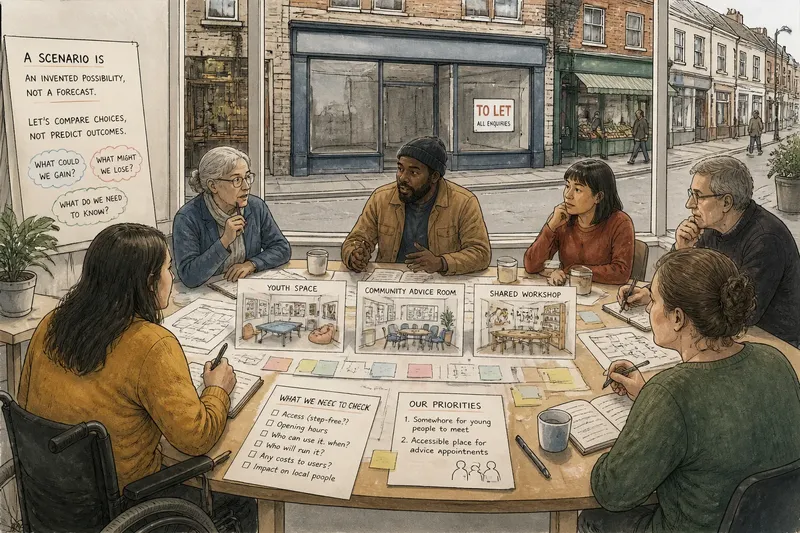
The Clean-Break Myth: Change Also Carries Things Forward
Continuity and change in local futures helps residents compare proposals by showing which shared purposes may continue, what must change and what remains unsettled.
How can residents consider a new local proposal without treating every existing arrangement as either sacred or disposable? Continuity and change in local futures offers a way to compare the decision itself: what would alter, which shared purposes might carry on, and what still needs to be settled.
This is not a case for preserving the status quo. It is a way to make trade-offs discussable before a proposal becomes a choice between a perfect past and a blank future. The focus is on the transition and the decisions residents can influence.
Define the decision
Start with a specific civic question: should a council trial a new format for public meetings, revise how it gathers comments on a planning proposal, or change the way a residents’ group allocates speaking time? Keep the subject narrow enough that people can identify the decision-maker, the choices still open and the point at which a response is due.
Separate the proposal from its sales pitch. “Make participation more inclusive” expresses an aim, not a decision. A clearer account might say that the council is considering evening meetings alongside daytime sessions, while the schedule and arrangements for remote contributions remain open. Residents can then discuss the actual options rather than infer what a slogan promises.
Distinguish purpose from method
Ask what a civic process is meant to make possible, then distinguish that purpose from the method currently used. A meeting in a council chamber is one format; giving residents a chance to question elected representatives is a purpose. A paper consultation is one method; collecting considered responses to a planning proposal is a purpose.
Purpose does not make every method interchangeable. A public meeting may allow immediate questions, while a written response gives someone time to compose a careful objection. Record these differences rather than claiming that a new format will replace everything the old one offered.
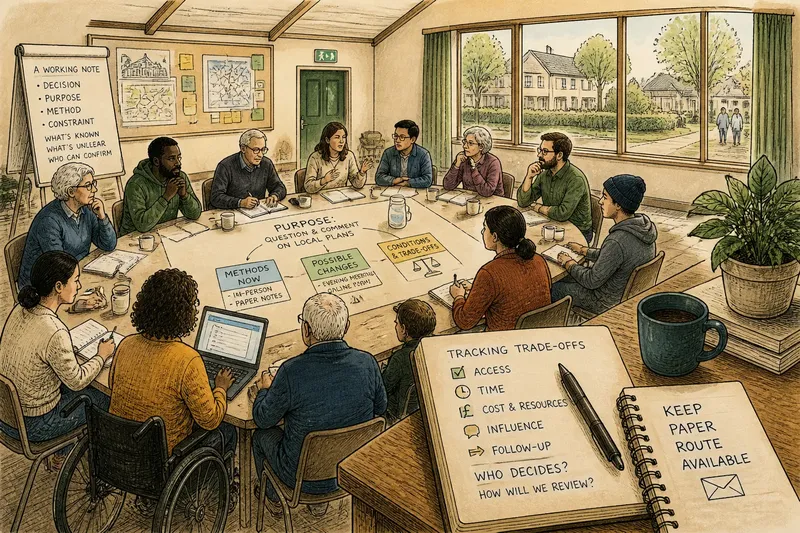
A working note can keep the discussion precise:
- Decision: What can the responsible body actually change?
- Purpose: What should the process enable residents to do?
- Method: How does the current arrangement support that purpose?
- Constraint: What limits the options, and who can confirm it?
For each item, note the source of the information and what remains uncertain. If the council has not confirmed whether a meeting room is available, record that as an unresolved constraint, not as a settled reason to reject an option.
Track the trade-offs
Compare the possible changes in practical terms. A meeting moved to an evening may suit some residents and conflict with others’ caring responsibilities. An online channel may make it easier to submit a comment but harder to hear follow-up questions. These are possibilities to discuss, not outcomes to announce in advance.
- If the proposal changes the meeting time, ask who can attend now and who may be excluded; if the answers differ, consider offering another route to take part.
- If comments are collected online, check whether people can also respond on paper; if not, ask for a non-digital option before treating the channel as accessible.
- If speaking time is shortened, check whether residents still have a way to ask follow-up questions; if they do not, consider a written response period or a separate question session.
- If a new format is described as a trial, check who will decide whether it continues; if no decision point is named, ask the responsible body to clarify the review process.
- If the proposal depends on staff or room availability, check which arrangements are confirmed; if they are not, keep the option conditional rather than presenting it as settled.
- If one group’s concerns are missing from the discussion, check who has not yet been heard; if access or timing may be the barrier, offer a different way to contribute.
These checks do not turn civic discussion into a scorecard. They expose where a choice may shift effort, access or influence, so residents can ask for a change to the proposal or explain why a trade-off is unacceptable.
Work through a proposal
Say, in an invented situation, a residents’ association currently holds monthly planning discussions in a community hall on weekday afternoons. The association is considering an evening meeting and an online comment form. The chair has confirmed that the hall can be booked in the evening, but the association has not decided whether paper comments will still be accepted.
First, residents identify the decision: whether to change the meeting time and add an online channel. Next, they separate the purpose—letting neighbours question and comment on local plans—from the current methods of an in-person discussion and paper notes. They then identify a trade-off: an evening may suit people who work during the day, while the online form may not serve residents who prefer paper or need a conversation to explain their view.
The resulting account is specific: the association could try an evening meeting, keep paper comments available, and use the online form as an additional route; it still needs to decide how questions will receive replies. The observable decision is not whether everyone prefers the new arrangement, but whether the association adopts those conditions, revises the proposal or keeps the existing format while it resolves the open question. The method changes, while the purpose of public discussion remains in view.
Think of a civic process as a shared table: changing its place or shape can alter who can reach it, even if people still intend to meet around it. Unlike a household table, the process must account for different interests and public responsibilities.
Questions about civic change?
How can residents challenge a proposal?
Ask which part is open to influence, who holds the decision and when comments will be considered. Then make a specific request, such as retaining a paper response route, rather than objecting only to a broad aim.
What if residents disagree about what matters?
Record the competing concerns in plain language and avoid presenting one account as the community’s single view. The decision-maker can then see which trade-offs need an answer and which residents may be affected differently.
How should an unconfirmed detail be described?
State what is known, what is not known and who is responsible for clarifying it. Keep any dependent benefit or disruption conditional until that detail is settled.
Does continuity mean keeping the same process?
No. A different format can retain a purpose, such as enabling questions or gathering considered views, while changing how people take part. Residents should still examine which useful opportunities the new method might remove.
Make the account usable
Write a short shared account with four parts: the decision under consideration, the purpose residents want the process to serve, the changes proposed and the questions still open. Use direct wording. Replace “modernise engagement” with the actual change, and avoid claims that no one will lose access unless the arrangements support that claim.
Before the account is used in a meeting or sent to a council, ask people with different interests to identify missing options and unsupported assumptions. Their responses need not produce agreement. A useful account lets residents see what is being decided, what can still be changed and where further information is needed.
Continuity and change in local futures is most useful when it leads to a clearer civic choice, not a polished description of one. Keep the unresolved conditions attached to the proposal as it moves forward; otherwise, a possibility can quietly be mistaken for a commitment.