The Layers of a Place: What Belongs in a Local Portrait?
A local portrait can feel incomplete when it misses memory, routine or surroundings. Use three prompts to make a fuller, more grounded account.
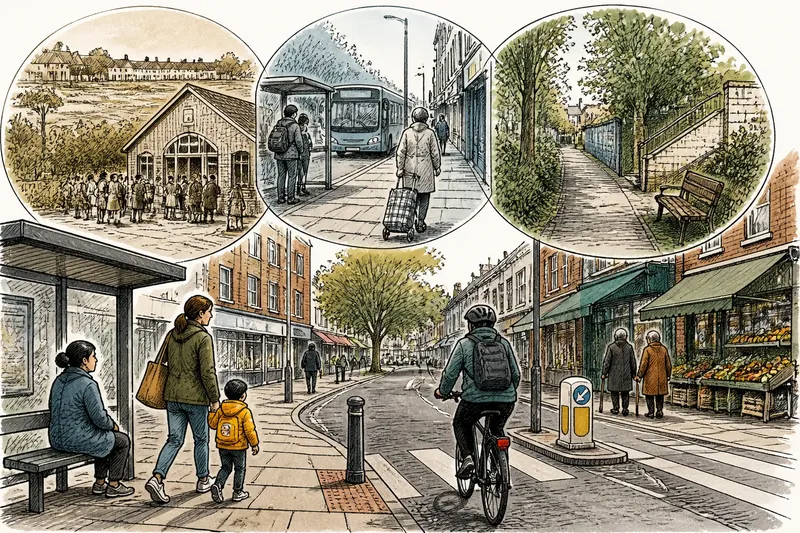
What belongs in a local portrait when neighbours describe the same street in sharply different ways? A useful local portrait holds three layers together: memory, routine and physical surroundings. Trouble begins when one layer is mistaken for the whole place, leaving some residents unable to recognise their own experience in the account.
This is not a contest to produce the most lyrical description or settle whose version is correct. The task is to notice what each account includes, what it leaves out and what might explain the gap. A simple three-part prompt—what is remembered, what happens repeatedly, and what is physically here—gives a group a steady way to build a fuller picture.
When memory takes over
A conversation can quickly become a collection of remembered landmarks: the shop that closed, the field before new homes arrived, the room where a club used to meet. These details matter because they show what people feel has changed or been lost. But if the portrait stays in the past, it may tell little about how the area is inhabited now.
The cause is often not nostalgia alone. Memory is easy to summon in a group: one person names a familiar place, and another adds a story. Present-day routines are less readily visible, especially when they happen privately or at ordinary hours. The discussion can therefore over-represent events and places that lend themselves to a story.
Try giving memory its own prompt rather than allowing it to fill every prompt: What do people remember here, and what does that memory tell us they value? Record the value as well as the event. A recollection of a busy community hall, for instance, might point to the importance of having an affordable indoor place to meet, even if the hall itself is no longer available.
Then ask what happens around that remembered absence today. A closed building may now be a route past, a blank wall, a site people avoid, or a place where a new activity has taken root. The portrait need not resolve disagreement about whether the past was better. It can preserve the memory while making room for the present.
When routines disappear
Some accounts focus on major occasions and named institutions but miss the repeated, modest actions that make an area usable. People may walk a particular way to the bus stop, wait outside a school, collect groceries after work, or sit where a path catches the afternoon light. Such patterns rarely sound remarkable when recounted one at a time, yet together they reveal how a place works in daily life.
Routines disappear from a portrait when the group asks only what is distinctive or memorable. The result can describe a place as a list of attractions rather than a setting people move through. It can also leave out residents whose time is organised around care, shift work, mobility needs or a short visit between other obligations.
Use the second prompt: What do people do here repeatedly, and which routes, timings or meeting points make those routines possible? Ask about ordinary days as well as special occasions. If people are comfortable, invite them to describe a typical journey without asking for personal details they do not want to share.
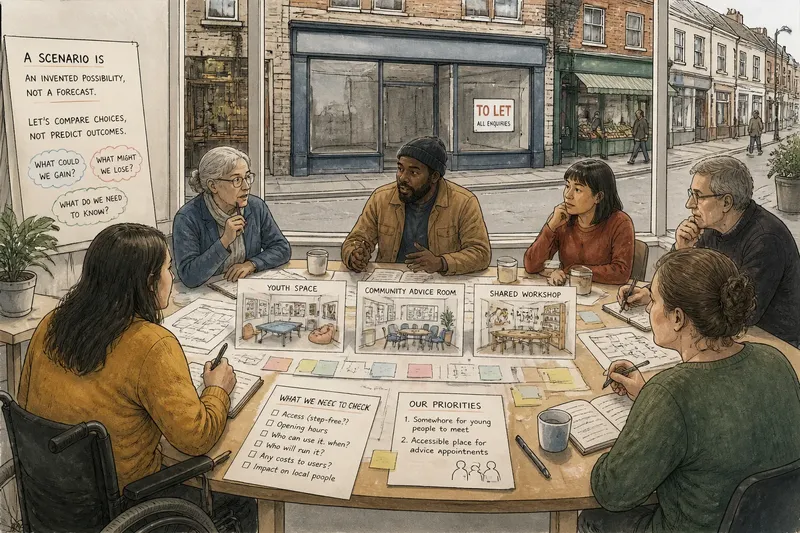
Say a neighbourhood group is preparing a portrait of a high street and keeps naming festivals and shop openings. Imagine one member suggests tracing an ordinary errand instead: where someone enters, where they pause, which crossing feels awkward, and where they can ask for help. The group adds a short account of that journey beside the event memories, making a previously invisible pattern available for discussion.
Routines are not proof that everyone has the same experience. One person’s convenient shortcut may be another person’s difficult or unwelcome route. Record differences without forcing them into a single representative journey; they may indicate which parts of the area deserve closer attention.
When surroundings become scenery
Physical surroundings can be reduced to a backdrop: a park, a row of houses, a river, a main road. Naming features is a start, but it does not yet explain how they shape experience. A path can connect two places while also feeling exposed; a shopfront can offer a place to stop as well as a service; a blank boundary can affect how people understand the edge of a neighbourhood.
This layer is often thin because people describe what is visible but not what it permits, interrupts or excludes. Maps can reinforce the habit: they show streets and buildings clearly, while shade, noise, waiting, informal gathering and perceived welcome take more effort to record. A physical portrait should therefore connect features to what people notice and do, without claiming that every observer sees them alike.
Use the third prompt: What is physically here, and how does it shape movement, meeting, comfort or access? Name specific features, such as a bench, a steep approach, a covered entrance, a busy junction or a stretch with few places to pause. Pair each observation with the experience people associate with it, and leave room for contrasting accounts.
A plain analogy may help: a place is like a well-used coat. Its seams and pockets are the visible structure, while the marks and habits of use explain why someone keeps reaching for it. Neither the material nor the wear tells the entire story on its own.
When one voice stands in
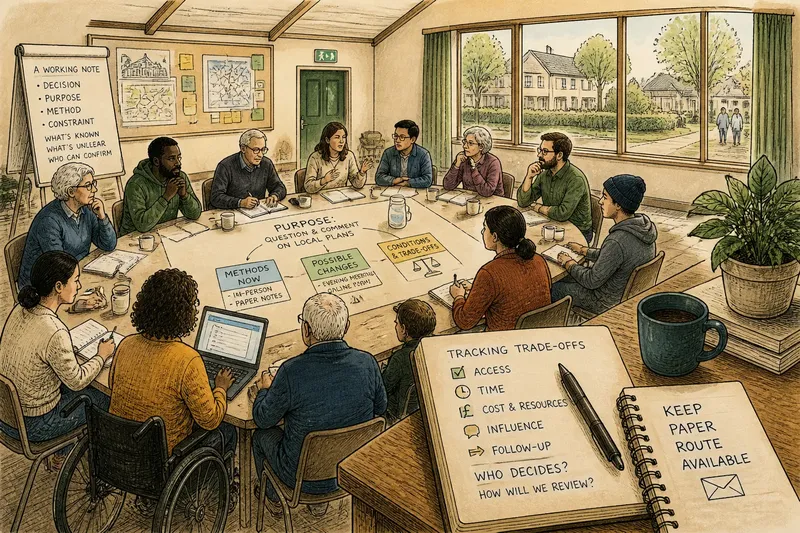
A portrait can contain all three layers and still feel partial if a small, confident group is treated as the whole community. This often happens when meetings are the main source of material. People who can attend, enjoy speaking in public or already know one another may supply most of the memories, routines and observations.
Do not try to solve that gap by inventing a typical resident. Instead, mark whose accounts are present and which experiences have not yet been heard. Offer different ways to contribute: a brief written note, a conversation at a familiar local venue, or a chance to comment on a draft. Keep participation voluntary and avoid collecting sensitive details without a clear reason.
When reviewing the portrait, ask whether it treats an observation as shared fact or attributes it to the people who expressed it. “Residents feel unsafe here” can overstate agreement; “some contributors said they avoid the junction after dark” keeps the claim closer to its source. That distinction makes the account more useful, not less.
When details overwhelm
The opposite problem is a portrait so crowded with anecdotes, street names and descriptions that a reader cannot tell what matters. It usually comes from trying to preserve every contribution at equal length. A fuller account does not need to be an exhaustive catalogue; it needs enough detail to show how the layers meet.
Group related observations, but do not erase differences that change their meaning. A memory of a former meeting place, a present-day route past its site and the remaining doorway might belong together. The connection helps a reader see how the place is remembered, used and encountered now, without pretending that the three details say the same thing.
For each cluster, keep one concrete detail and ask what it helps explain. If a detail adds neither a distinct experience nor a useful connection, it may belong in a record of contributions rather than the main portrait. This is an editorial choice, not a judgement about whose memory matters.
Questions for a fuller portrait?
How do you start a local portrait?
Invite people to respond to the three prompts separately: memory, repeated activity and physical surroundings. Separate notes make it easier to see which layer is missing before the group combines them.
How can you include quieter voices?
Offer a few low-pressure ways to contribute, including written comments and one-to-one conversation, rather than relying only on a public meeting. Make clear that people may pass on a question or keep their contribution unattributed.
What should you do with conflicting accounts?
Keep the accounts side by side and describe who holds each view where that information is appropriate. A disagreement can reveal different routes, histories or needs; it does not have to be settled to belong in the portrait.
How can you tell if the portrait is balanced?
Check whether memory, routine and surroundings each have concrete detail, and whether the account distinguishes observations from shared conclusions. Ask someone who contributed less often to read it and say what feels absent or misrepresented.
Keep the layers together
A local portrait becomes more useful when it does not ask one kind of evidence to carry the entire description. Memory shows what people hold onto; routine reveals how the area is lived; physical surroundings give those experiences a setting. The three-part prompt is a way to notice omissions, not a form that every place must fill evenly.
As the account develops, keep the prompts beside the draft and use them when a passage feels too certain, too nostalgic or too abstract. A local portrait can then hold an old gathering place, a present-day errand and the shape of the street in the same frame. That is a grounded starting point for imagining what residents might want to preserve, alter or make possible.